
Quick answer: a complete IELTS system run over 42 days. Forty-seven masterclasses, about 15 hours and 40 minutes of teaching, with Academic and General Training tagged day by day so you study only your road. Thirty-two full Reading and Listening papers are marked by the portal, and every one of roughly 1,280 questions carries a written explanation of why the right answer is right and why each wrong one was put there to catch you. Fifty-six Writing tasks and twenty-nine Speaking papers sit alongside them. Built for the computer test from day one. $225 once, both tracks, lifetime access.
You have watched the free videos. Everyone’s free videos. And your band has not moved, because tips are not a system and motivation is not a method. This course is the method, and this page shows you the whole of it before you pay a rupee, a riyal or a pound.
Why your band has not moved
Watching somebody else solve a Reading passage is reassuring, and it is the most convincing illusion in language learning. It feels like competence. Then you sit in front of the real screen, the sixty minute clock starts, and a passive tip gives you nothing to do with your hands.
There is a second problem, and it is quietly worse. Most courses on sale today were recorded for the paper test. They tell you to underline keywords with a pencil, to flip back through a booklet, and to use the ten minutes at the end of Listening to copy your answers across.
On the computer test there are no ten minutes. There are two. If you have not trained type as you hear, if you do not know how the screen scrolls and where the review flags are, you lose marks to the interface before you lose a single one to your English. → What the change actually means
What is actually inside: all 42 days
Six weeks. Each week teaches a layer of method and then makes you sit something that proves it has landed.
| Week | What it builds | Masterclasses | Teaching time | Papers set |
|---|---|---|---|---|
| 1 · Days 1 to 7 | The complete method in every skill: Listening, Reading, Speaking, both Writing tasks | 8 | about 4 h 56 | 8 |
| 2 · Days 8 to 14 | Paraphrase, and the first question types that trap people | 7 | about 2 h 24 | 7 |
| 3 · Days 15 to 21 | Vocabulary for band 7, and every matching task | 8 | about 2 h 21 | 2 |
| 4 · Days 22 to 28 | Grammar for band 7, maps, plans and diagrams | 8 | about 2 h 07 | 2 |
| 5 · Days 29 to 35 | Linking and cohesion, then full tests under the clock | 8 | about 2 h 09 | 10 |
| 6 · Days 36 to 42 | Exam ready: two mocks, their reviews, and test day | 8 | about 1 h 42 | 9 |
Of the 42 days, 35 are masterclass days, four are weekly check days where you sit a paper instead of watching, two are full mock tests and the last is your final review.
And here is the same course cut by skill, so you can see where the hours actually go.
| Skill | Masterclasses | Teaching time | Track |
|---|---|---|---|
| Writing Task 2 | 7 | about 3 h 24 | Both tracks |
| Listening | 5 | about 1 h 56 | Both tracks |
| Reading | 7 | about 1 h 54 | Both tracks |
| Speaking | 6 | about 1 h 54 | Both tracks |
| Writing Task 1, charts and processes | 6 | about 1 h 44 | Academic only |
| Writing Task 1, letters | 6 | about 1 h 51 | General Training only |
| Foundations: paraphrase, grammar, cohesion | 4 | about 1 h 08 | Both tracks |
| Vocabulary and topic ideas | 2 | about 37 min | Both tracks |
| Exam ready and test day | 3 | about 33 min | Both tracks |
| Start here | 1 | about 37 min | Both tracks |
Forty-seven masterclasses, 15 hours and 43 minutes in all. Your track skips the other one’s Writing Task 1, so an Academic student watches 40 of them and a General Training student watches 40, a little under 14 hours either way. The lectures are deliberately short. A 15 minute masterclass you finish beats a 50 minute one you abandon, and the hour that matters is the one you spend on the paper afterwards.
Thirty-two marked papers, and every question explained
This is the part most courses do not have, and it is the reason this one works in six weeks. The course is not a video library with a quiz bolted on. It is a test engine with lectures in front of it.
- 15 full Listening papers with original recordings, forty questions each, played once through exactly as the real test does it.
- 14 full Academic Reading papers and 3 General Training Reading papers, forty questions each, under a sixty minute clock.
- 56 Writing tasks and 29 Speaking papers, with model answers at contrasting bands.
- Two full mock tests on days 38 and 40, each with its own review day afterwards.
That is roughly 1,280 marked questions across the Reading and Listening papers alone. Every single one carries a written explanation: what the passage or the recording actually says, where the answer sits, and what each wrong option was put there to do to you. Not an answer letter. Not a tick. A reason.
On a Listening paper the review screen gives you a play button on every question that takes you to the exact second the answer was spoken, so you can hear the thing you missed instead of wondering what it was.
What a day actually looks like
- One masterclass. Usually 12 to 20 minutes, built around one question type or one task, with the computer screen on screen.
- The day’s paper, where there is one. Forty questions, marked the moment you submit, with the explanations unlocked afterwards and not before.
- Your error log. Every wrong answer is filed by the reason it was wrong, not by the question number. That list becomes your revision syllabus, and it is personal to you.
- A six question check on eighteen of the lectures, the foundation ones, where getting the idea wrong early would cost you for weeks.
In Writing and Speaking you also get sample answers at contrasting bands on the identical task. Weak samples are included on purpose: seeing exactly why an answer is a band 5.5 teaches more than admiring a band 8.
The five honest differences
- Built for the computer test from day one. The on screen player, type as you hear Listening, the two minute reality, the review flags, the timer habits. IELTS is withdrawing the paper test from mid 2026, and a course recorded in the paper era is teaching a format that is leaving. → What the change actually means
- Everything is original. Every passage, chart, letter, essay question and audio script was written new for this course. No recycled past papers, no channel files, no answers you have accidentally memorised from a Telegram group. Here is why that matters more than it sounds.
- The samples were graded blind. An independent reviewer rated every Writing and Speaking sample without seeing its label, and where the blind rating disagreed with the label, the label changed. Ask any other course what their samples would score under a blind review.
- An estimated band is called an estimated band. The portal gives you an estimate and the reasons behind it. This page will never call that an official score, because only the exam boards issue those.
- The error log method. Scores are weather. Mistakes are facts. Every wrong answer gets a reason, every reason gets a lesson, and the lesson list becomes your personal syllabus. It is the same method behind our OET results, and it is the whole reason the course is built to work in six weeks rather than six months.
Who this course is for, honestly
For you if you are preparing for the computer delivered test, Academic or General Training; if you want a system instead of scattered tips; if you can give it about two hours a day for six weeks; and if you are aiming at band 7 and above for a university, a healthcare licence or immigration.
Not for you if your exam is next week, if you are sitting the paper test, or if you want a guaranteed band. Nobody honest sells those, and the band descriptors explain why.
One price. Lifetime access.
$225 USD, paid once. Both tracks. No subscription, no upsell, no second tier.
What that includes:
- All 47 masterclasses, both the Academic and the General Training track
- All 32 marked Reading and Listening papers, with every question explained
- 56 Writing tasks and 29 Speaking papers with contrasting band models
- Two full mock tests and their review days
- The error log, built from your own wrong answers
- Every paper and lecture added after you join, at no extra charge
The arithmetic. One IELTS booking costs between $250 and $330. If you miss your band by half a point and sit it again, the retake alone costs more than this entire course. This is cheaper than being half a band short once.
Opening now · $225 once, both tracks
The complete IELTS course by Dr. Nasir
42 days, 47 masterclasses, 32 marked papers, built for the computer test. Leave your email and we will open your account and send you the way in.
One email about the course, and nothing else. Your address is never sold or shared. Privacy policy.
The questions everyone asks
Academic or General Training? Both are inside, tagged day by day. Academic students take the charts and processes Writing Task 1 and skip the letters; General Training students take the letters and skip the charts. Everything else is shared. If you do not yet know which one your organisation needs, decide that first, free, on our Academic or General Training page.
How long does it take? 42 days at about two hours a day, one hour of teaching and one hour of paper. If your schedule is tighter you can run it over twelve weeks at an hour a day. The days are numbered, so the course always tells you where you are.
How long do I have access? Lifetime. Including every paper and lecture added after you join.
What if I am stuck at band 6.5? That is the exact profile this was built for. The error log is the mechanism: it stops treating your score as a mood and starts treating your mistakes as a list of named, fixable things.
Is the feedback an official score? No, and no course can give you one. You get an estimated band with the reasons behind it. Official bands come from one place only, the exam.
Want to taste the Speaking system first? The 12 templates are free, with no email wall. → Download the templates
Want the free version of each skill first? All four are written out in full: Listening · Reading · Writing · Speaking
About the author
Dr. Nasir Bukhari is the Executive Director of CliniVerba and a practising doctor (MBBS). He is an officially trained English test teacher, certified in all four skills by OET’s Head of Education, and has taught healthcare professionals and migrants in more than 40 countries.
 View full size
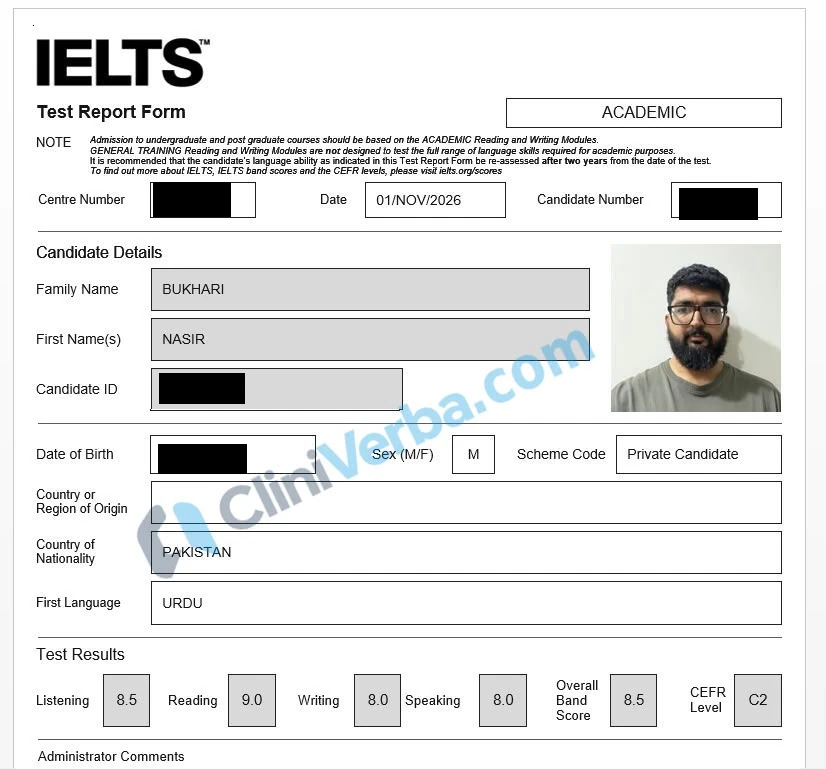
His own Test Report Form · 1 November 2026
Overall band 8.5, CEFR level C2
Academic module, sat three weeks before this page was written. The teacher who wrote this course sat the exam it prepares you for, on the version of it you are about to sit.
Centre number, candidate number, candidate ID and date of birth are blacked out. The scores, the date and the module are not. More about Dr. Nasir.
He teaches the test from inside it, which is the whole argument for this course: a teacher who does not sit the current exam is teaching the old one.